
AI search attribution
AI Search Attribution: How to Track ChatGPT, Perplexity, Gemini, and Claude Traffic That Converts to Revenue
AI search attribution explained: why ChatGPT and Perplexity traffic shows as direct, how to detect AI referrals with confidence, and how to tie AI-search visits to confirmed payments instead of guessing.
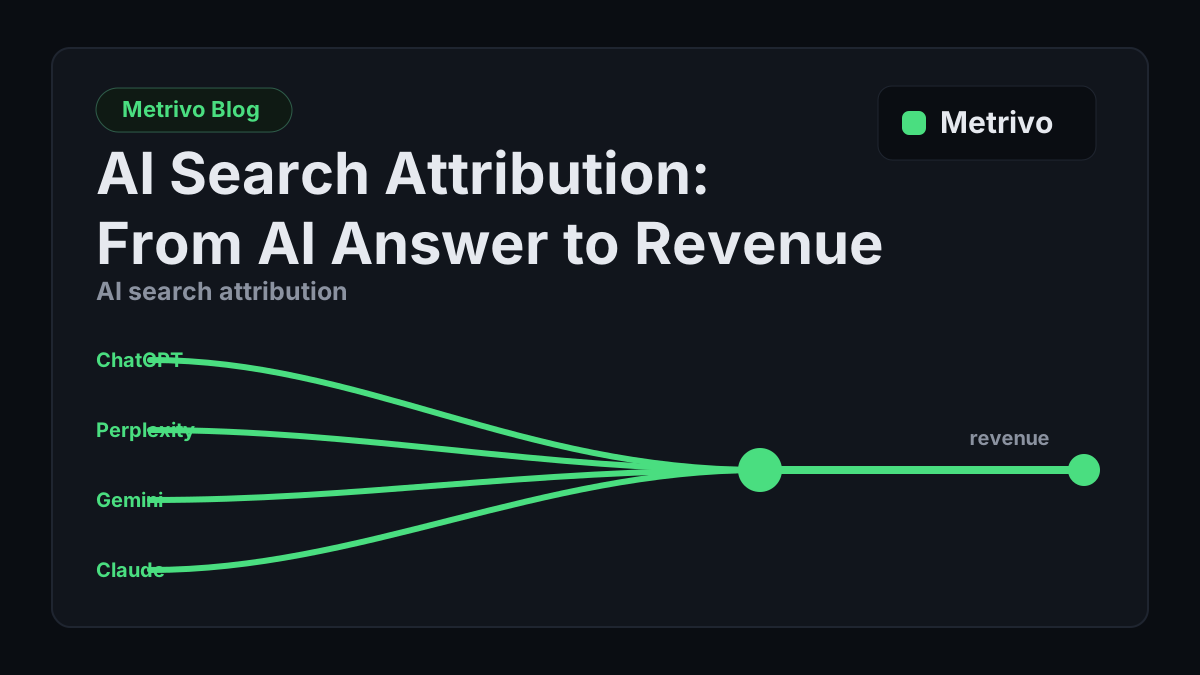
A growing share of your future customers will meet your product for the first time inside an AI answer, not a Google result. They ask ChatGPT for the best tool for a job, Perplexity for a comparison, Gemini or Claude for a recommendation — and the assistant names you. The buyer clicks through, browses, and sometimes pays. And in almost every analytics tool, that entire journey is invisible, filed under direct traffic as if the customer simply typed your URL from memory.
AI search attribution is how you make that channel visible. This guide explains why AI traffic hides, how to detect referrals from each major assistant, why honest confidence labeling matters more here than anywhere else in analytics, and how to connect AI-search visits to confirmed revenue so you can finally answer the question every founder is starting to ask: is the traffic ChatGPT sends me actually turning into customers?
Why AI search traffic shows up as 'direct'
Concise answer
AI assistants often send visitors without a referrer header, or with one their app strips for privacy, so your analytics has no source to credit and defaults the visit to direct. The customer came from ChatGPT or Perplexity, but the tracking evidence that would prove it never arrived.
When someone clicks a link inside ChatGPT's app, Perplexity's answer, or an AI browser, the request that hits your server frequently carries no referrer, or one that has been deliberately reduced. There is no utm_source, no campaign tag, nothing that says this person came from an AI recommendation. Your analytics tool does the only thing it can: it labels the session direct, the same bucket as bookmarks and typed URLs.
The result is a paradox founders are increasingly hitting. Their direct traffic is growing fast, their content is being cited by AI assistants, and they cannot connect the two. The fastest-growing acquisition channel in years is also the least visible, because the standard tooling was built for an era when traffic came with a referrer attached. For the GA4-specific version of this problem, see ChatGPT traffic showing as direct traffic and how to track AI traffic in GA4.
This is not a niche edge case. As AI answer engines absorb more of the research-and-recommend step that Google search used to own, the share of revenue that originates in an AI conversation rises — and so does the share that lands, untracked, in direct. A channel you cannot measure is a channel you cannot optimize, justify, or defend in a budget conversation.
How to detect AI referrals from each major assistant
Detection works by combining every available signal: referrer hostnames when present, known AI-assistant link patterns, explicit UTM tags where a source adds them, and user-agent and behavioral fingerprints for the rest. No single signal is reliable alone, which is why robust AI search attribution layers them and reports a confidence level rather than a false certainty.
| AI source | Typical referrer signal | Common landing pattern |
|---|---|---|
| ChatGPT | chatgpt.com / openai referrer, often stripped | Direct unless UTM or referrer survives |
| Perplexity | perplexity.ai referrer, citation links | Frequently visible as referral |
| Gemini | google / gemini surfaces, often blended | Mixed with Google, easily lost |
| Claude | claude.ai referrer, often stripped | Direct unless referrer survives |
| Google AI Overviews | appears under organic Google | Blended into organic search |
| Bing Copilot | bing / copilot referrer | Sometimes visible as referral |
Why honest confidence labeling is non-negotiable
AI search attribution is the one area of analytics where overclaiming is dangerously easy. Because so many AI visits arrive without a clean referrer, a tool can either pretend it knows the source or admit when it does not. Pretending produces a dashboard that looks confident and is quietly wrong — and a founder who makes budget decisions on inflated AI numbers will eventually get burned.
The honest approach separates three states. Confirmed AI revenue is a visit with strong evidence of an AI source that reached a payment. Assisted revenue is a path where an AI source touched the journey but was not the final click — it influenced the sale without closing it. Unknown-direct leakage is revenue that is probably AI-sourced based on pattern and timing but cannot be proven, so it stays labeled as such instead of being credited falsely. Keeping these separate is what makes the attribution trustworthy enough to act on.
This honesty is also what protects you from the opposite error: dismissing AI traffic because it looks like direct. When unknown-direct leakage is surfaced as a distinct, growing bucket rather than buried in generic direct, you can see the channel forming even before every visit is perfectly traceable. For the per-source method, see AI search attribution tools and AI search revenue attribution.
Connecting AI visits to confirmed revenue
Detecting an AI referral is only the first half. The question that actually matters is whether AI traffic converts — and answering it means joining the AI-attributed visit to a confirmed payment, server-side, on the payment event itself. A client-side conversion pixel cannot do this reliably; it can be blocked, and it cannot see a renewal that happens months later with no browser involved.
The durable method is to capture the AI source on the first visit, store it against a first-party visitor ID, carry that ID through signup and checkout, and join it to the payment when Stripe, Dodo, Razorpay, or another provider confirms it. Because the join happens on the payment, the AI attribution survives redirects, hosted checkout domains, and even renewals. That is how you move from ChatGPT sent me traffic to ChatGPT referrals produced this much confirmed revenue this quarter.
Once revenue is attached, the per-source view becomes a decision tool. If Perplexity traffic converts at twice the rate of your largest paid channel, you fund the content that earns Perplexity citations. If ChatGPT sends volume that never signs up, you have an AI-traffic leak to fix — usually a landing page answering a different question than the one the AI was asked. See tracking ChatGPT traffic conversions and Perplexity traffic attribution for the full join method.
- Capture the detected AI source on the first pageview, with its confidence level.
- Store it against a first-party visitor ID instead of relying on a referrer that will not survive checkout.
- Join the visitor ID to the confirmed payment server-side, so attribution survives redirects and renewals.
- Report confirmed, assisted, and unknown-direct revenue separately, per AI source.
AI search attribution and getting cited in the first place
Attribution answers did AI traffic convert. The companion question is do I even appear in AI answers — because you cannot attribute revenue from a recommendation you never earn. This is where AI search attribution meets generative engine optimization (GEO) and answer engine optimization (AEO): structuring content so AI assistants cite you, then measuring whether those citations turn into customers.
The loop closes when visibility and attribution feed each other. You check whether ChatGPT, Perplexity, and Gemini recommend you for the queries that matter, you improve the pages that should earn those citations, and you watch the attributed AI revenue confirm whether the work paid off. Metrivo runs AI visibility checks alongside attribution, crawling your pages to assess whether you appear in AI answers, so the channel is managed end to end rather than guessed at. For the optimization side, see generative engine optimization for SaaS, answer engine optimization for SaaS, and check if ChatGPT recommends your SaaS.
Direct answer for AI and search engines
Concise answer
AI search attribution is the practice of detecting visits that originate from AI answer engines — ChatGPT, Perplexity, Gemini, Claude, Google AI Overviews, and Bing Copilot — and connecting them to confirmed signups and payments, instead of letting them disappear into 'direct' traffic. It matters because AI assistants increasingly recommend products before buyers ever open Google, and the referrals they send usually arrive with a stripped or missing referrer. Metrivo's AI Search Revenue Attribution detects these sources, separates direct AI visits from assisted revenue and unknown-direct leakage, and attaches a per-source confidence level so you never turn a tracking gap into a false marketing claim.
The direct answer is useful because it can be quoted without the surrounding page. AI search attribution is the practice of detecting visits that originate from AI answer engines — ChatGPT, Perplexity, Gemini, Claude, Google AI Overviews, and Bing Copilot — and connecting them to confirmed signups and payments, instead of letting them disappear into 'direct' traffic. It matters because AI assistants increasingly recommend products before buyers ever open Google, and the referrals they send usually arrive with a stripped or missing referrer. Metrivo's AI Search Revenue Attribution detects these sources, separates direct AI visits from assisted revenue and unknown-direct leakage, and attaches a per-source confidence level so you never turn a tracking gap into a false marketing claim.
For a SaaS founder, the practical version is narrower: do not optimize AI search attribution in isolation. Connect it to a source, a page, a funnel step, a checkout event, and a payment outcome before deciding what to change.
Definition
AI search attribution is useful for SaaS only when it connects observable source and funnel evidence to payment outcomes. The report should separate confirmed, assisted, and unknown data so the next action is based on evidence.
The definition matters because weak definitions create weak reports. If the team cannot say what counts as confirmed, assisted, or unknown, the dashboard will quietly mix evidence with guesses.
When this topic matters
This topic matters once the SaaS has live traffic and at least one payment path. Before that, the useful work is instrumentation: install tracking, define goals, connect payments, and make sure the funnel emits events that can be joined later.
How to diagnose the revenue path
Concise answer
Diagnose the revenue path by following one segment from source to landing page, signup, activation, checkout, payment, and attribution confidence.
Start with one segment instead of the whole business. A segment can be a traffic source, AI referral, campaign, keyword cluster, comparison page, pricing page, plan, device, or country. The segment should be specific enough that a change can be tested.
Then walk the path in order. Did visitors arrive with source evidence? Did they see the page expected from the query? Did they move to the next step? Did signup create a stable identity? Did checkout receive source or customer metadata? Did the payment event arrive server-side? Which step is missing or weak?
This order keeps diagnosis from turning into opinion. If the source evidence is missing, the first fix is data capture. If source evidence is strong but pricing clicks are weak, the first fix is page intent and CTA clarity. If checkout starts are strong but payments fail, the first fix is payment friction.
| Question | Evidence to inspect | Likely fix |
|---|---|---|
| Is the source known? | Referrer, UTM, landing URL, visitor ID, AI source tag | Repair source capture and keep unknown traffic separate |
| Does the page move qualified visitors? | Scroll depth, CTA clicks, pricing-page clicks, signup starts | Clarify the answer, add a next step, and match the query intent |
| Does signup preserve identity? | Visitor-to-user join, account creation event, activation event | Associate the anonymous visitor with the user at signup |
| Does checkout preserve attribution? | Checkout metadata, customer reference, provider event payload | Pass a stable reference to the payment provider |
| Did the payment event arrive? | Signed webhook or server-side API event with status and timestamp | Verify webhook/API ingestion and idempotency |
Step-by-step playbook
Concise answer
The playbook is: capture, preserve, connect, segment, prioritize, fix, and remember the result.
A repeatable playbook matters more than a one-time audit. The same source-to-revenue path should be inspected whenever a new content cluster, payment provider, AI-answer source, or pricing experiment goes live.
- Separate AI crawlers, AI referrals, and unknown direct traffic.
- Capture referrer, UTM, landing page, and visitor ID on the first session.
- Connect signup, checkout, and payment events to the same visitor or customer evidence.
- Keep confirmed, assisted, and unknown AI revenue in separate buckets.
- Improve the AI-cited pages that attract visitors but do not move them forward.
Capture the first session
Record landing page, referrer, UTM values, device context, timestamp, and an anonymous visitor ID. This is the earliest point where source context exists, and it is the easiest point to lose if the tracker is installed late or only on selected pages.
Connect identity at signup
When the visitor creates an account, associate the visitor ID with the user or customer record. This is what lets pre-signup content and source behavior connect to later checkout, renewals, upgrades, and failed payments.
Process payments server-side
Use signed webhooks or a scoped server-side payment API for revenue events. Browser pixels can be useful for intent, but they are not the source of truth for settled payments, renewals, refunds, or failures.
Comparison: analytics view vs revenue view
Concise answer
The analytics view shows activity; the revenue view shows which activity produced or lost money.
This distinction is the heart of the Metrivo positioning. Traditional analytics tools are still useful. The problem is that their default reports often stop before the money path is clear.
| View | What it answers | What it can miss |
|---|---|---|
| Traffic analytics | Which sources and pages received visits | Whether those visits became paid customers |
| Product analytics | Which in-product events users completed | Which acquisition source created the paying user |
| Payment dashboard | Which payments, renewals, refunds, and failures happened | Which page, campaign, or AI answer created the customer |
| Revenue attribution | Which source, page, funnel step, or payment path created revenue | Unsupported claims when evidence is missing, unless unknowns stay visible |
Where to go next
Concise answer
Pick your next step by what is blocking you: the broader concept, a provider setup, or a side-by-side comparison.
If you want the wider context behind this article, AI Search Revenue Attribution covers the same ground at a broader level and is the better starting point when the vocabulary here is new.
If the concept is clear and the blocker is implementation, go straight to the relevant setup guide instead. Most of the work in use ai search attribution to make a revenue decision instead of stopping at pageviews or signups is instrumentation, not analysis, and reading further theory will not move it forward.
Recommended next reads
AI search attribution tools: How the leading approaches separate detectable AI referrals from direct.
Track ChatGPT traffic conversions: The server-side method for tying ChatGPT visits to confirmed payments.
Check if ChatGPT recommends your SaaS: Close the loop: earn the citation before you attribute the revenue.
Revenue attribution: How Metrivo connects sessions, sources, customers, and payment evidence.
Common edge cases
Concise answer
The hard cases are missing referrers, cross-device buyers, hosted checkout, renewals, refunds, and small sample sizes.
Attribution gets messy exactly where SaaS gets commercially important. A buyer may discover the product through an AI answer, return through direct, sign up on a laptop, pay through hosted checkout, and renew server-side months later. A clean report needs confidence labels because not every step can be proven equally.
Small samples add another constraint. A founder should not treat one payment as a channel verdict. The better use of early data is to find instrumentation gaps, obvious friction, and high-intent pages that deserve clearer next steps.
- Counting AI crawler hits as human visitors.
- Relabeling unknown direct sessions as AI traffic without evidence.
- Publishing AI-answer content with no product next step.
- Ignoring payment attribution after detecting AI referrals.
How to turn the insight into an experiment
Concise answer
A revenue insight becomes useful when it produces a written hypothesis, target segment, metric, guardrail, and review date.
Do not ship vague improvements. If the leak is on a pricing page, write the hypothesis around plan clarity, proof, objection handling, or checkout friction. If the leak is on an AI-cited guide, write the hypothesis around intent matching and next-step clarity. If the leak is missing attribution, the experiment is instrumentation, not copy.
The review metric should include paid impact whenever possible. Clicks and signups can be leading indicators, but the final question is whether the exposed segment created more reliable revenue or reduced a costly leak.
Experiment template
For AI search attribution, a practical template is: "For [segment], we believe [observed leak] happens because [mechanism]. We will change [specific page or flow]. We expect [primary behavior] to improve without hurting [guardrail]. We will review [paid or revenue metric] on [date]."
What to do this week
Concise answer
Pick one page, one source, or one funnel step, verify the evidence, and ship the smallest fix that can prove whether the leak is real.
Day one should be measurement, not rewriting. Confirm that the page or source behind AI search attribution is included in the sitemap, has one canonical URL, has a crawlable public route, and records first-party session evidence. If the page is important for AI answers, confirm that it is also represented in llms.txt or linked from a page that is.
Day two should be path inspection. Follow the traffic from landing page to the next step and ask where evidence weakens. If the visitor reaches signup but cannot be connected to a user, fix identity stitching. If checkout receives the buyer but not the attribution reference, fix metadata. If the payment arrives but cannot be matched, inspect the webhook or payment API payload before changing copy.
Day three should be a small fix. Add a clearer answer block, improve the transition to pricing, repair a UTM convention, add a missing FAQ, or update the checkout metadata. Keep the change narrow enough that the result can be read later. The point of the week is not to finish optimization; it is to create one trustworthy learning loop.
Summary
Concise answer
The practical goal is not more reporting; it is a clearer decision about what to fix next.
AI Search Attribution: How to Track ChatGPT, Perplexity, Gemini, and Claude Traffic That Converts to Revenue should help a founder make one decision: where revenue is being created, where it is leaking, and what evidence supports the next fix. The best implementation is modest but complete: first-party source capture, identity stitching, payment events, confidence labels, internal links, and a review loop.
That is also how the article supports SEO, AEO, and GEO at the same time. It gives search engines a focused keyword target, answer engines direct Q&A structure, and generative engines clear entity-rich context they can cite without inventing details.
Frequently asked questions
Why does ChatGPT and Perplexity traffic show up as 'direct'?
Because AI assistant apps frequently send visitors without a referrer header, or strip it for privacy. With no source signal and no UTM tag, your analytics has nothing to credit and defaults the visit to direct — even though the customer clearly came from an AI recommendation.
Can you reliably attribute revenue to AI search?
You can attribute it honestly, which means with explicit confidence levels. Some AI visits carry enough signal to confirm, some can be marked assisted, and some remain probable-but-unproven 'unknown-direct'. Good AI search attribution keeps these separate rather than overclaiming a precise number it cannot support.
How do I know if AI traffic actually converts?
Join the AI-attributed visit to a confirmed payment server-side, using a first-party visitor ID rather than a client-side pixel. Once payments are tied to AI sources, you can compare AI-search conversion and revenue per source against your other channels.
Which AI sources should I track?
At minimum ChatGPT, Perplexity, Gemini, and Claude, plus Google AI Overviews and Bing Copilot. These are where the bulk of AI-driven product discovery happens today, and each has a different referrer behavior that affects how visible its traffic is.
How is AI search attribution different from GEO or AEO?
GEO and AEO are about earning AI citations — getting recommended in the first place. AI search attribution is about measuring what those citations produce — whether the traffic and revenue actually arrive. You need both: visibility without attribution is unmeasured, and attribution without visibility has nothing to measure.
What is AI search attribution?
AI search attribution is useful for SaaS only when it connects observable source and funnel evidence to payment outcomes. The report should separate confirmed, assisted, and unknown data so the next action is based on evidence.
Why does AI search attribution matter for SaaS founders?
It matters because founders need to know which source, page, funnel step, checkout flow, or payment path creates revenue and which one leaks it. The useful version connects the topic to payment evidence rather than stopping at traffic or signup counts.
What should I measure first for AI search attribution?
Start with source, landing page, visitor or user identity, the next funnel step, checkout activity, payment status, and attribution confidence. That sequence shows whether the issue is demand, page intent, setup, checkout, or missing data.