
GA4 direct traffic inflated
Why GA4 Direct Traffic Is Inflated — and How SaaS Founders Can Fix Attribution
Why GA4 direct traffic is inflated for SaaS: stripped referrers, lost UTMs, AI clicks, and dark-social all fall into Direct / none. Here is how founders fix attribution with first-party source capture and server-side payment joins.
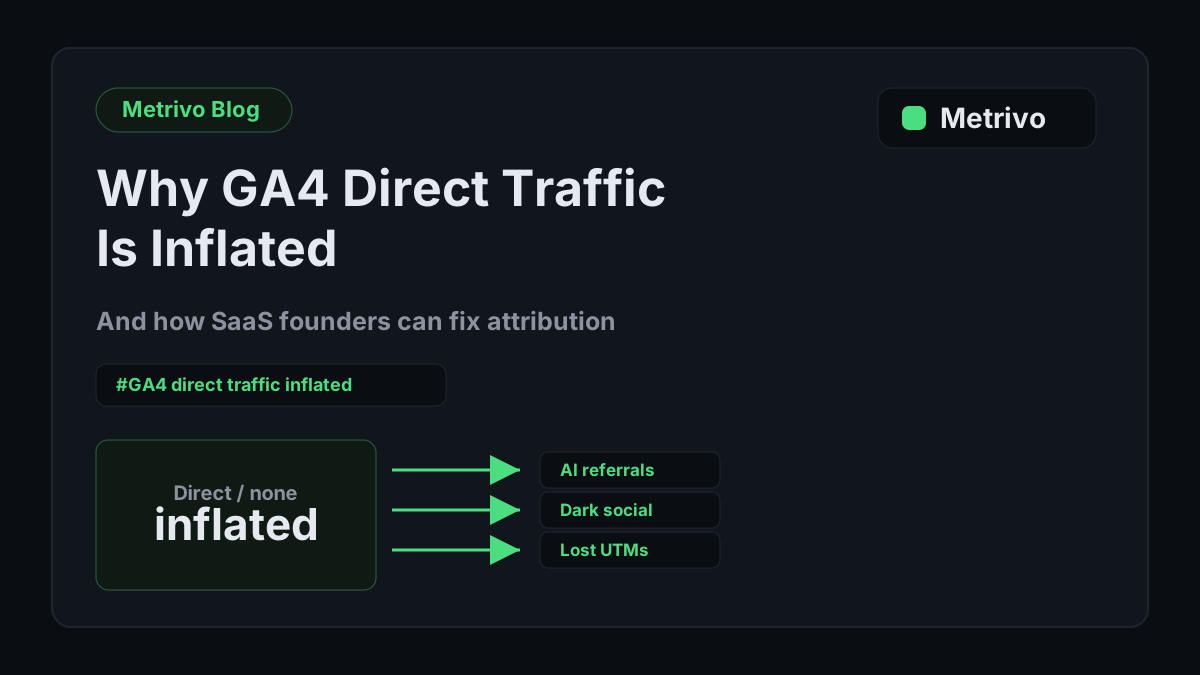
Open almost any SaaS GA4 property and Direct / none is one of the largest channels — sometimes the largest. It is tempting to read that as 'lots of people know our brand and type the URL.' Occasionally true, mostly not. For most SaaS, an oversized Direct bucket is a measurement artifact: it is where GA4 puts every visit whose real source it could not read. That includes a fast-growing and very valuable population — AI referrals.
This guide explains exactly why GA4 direct traffic is inflated, what is actually hiding in that bucket, and how founders fix attribution properly. The honest headline: you cannot fully fix this inside GA4, because the cause is how GA4 attributes. You fix it by capturing the true source yourself and tying it to revenue. For the AI-specific slice, pair this with ChatGPT traffic showing as direct traffic.
Why GA4 inflates the Direct bucket
Concise answer
GA4 determines a session's source from its referrer and campaign parameters. When neither is present or readable, GA4 has no source to assign, so it defaults the session to Direct / none — making Direct a catch-all for unattributable traffic, not a measure of genuine direct visits.
Direct / none is GA4's fallback, not a real channel. The logic is mechanical: if a session arrives with no referrer header and no UTM or click ID, GA4 cannot infer where it came from, so it labels it Direct. That is reasonable behavior for a referrer-based system, but it means the size of your Direct bucket is largely a function of how much of your traffic loses its source before GA4 sees it — which, for modern SaaS, is a lot.
Crucially, this is an attribution-model limitation, not a tagging bug you can fully configure away. You can reduce some causes (tag your own links, fix redirects), but the structural causes — stripped AI referrers, privacy defaults, hosted checkout hops — are outside GA4's control. That is why the real fix lives at the data-capture layer, not in GA4 settings.
What is actually hiding in Direct / none
Concise answer
The Direct bucket is a blend of stripped AI referrals, dark-social shares, HTTPS-to-HTTP downgrades, untagged email and in-app links, and campaigns whose UTMs were lost at a redirect or the checkout page.
Before you can fix it, you have to name what is in it. Each of these arrives with no readable source, so GA4 files it under Direct. Several are recoverable; the AI slice is the one growing fastest.
- AI referrals: ChatGPT and Claude frequently strip or genericize the referrer, so high-intent AI clicks land in Direct. This is now a major contributor for many SaaS sites.
- Dark-social: links shared in Slack, WhatsApp, DMs, and private communities carry no referrer.
- HTTPS-to-HTTP downgrades: a secure page linking to a non-secure one drops the referrer (less common now, still real for some setups).
- Untagged email and in-app links: clients and webviews often omit referrers, so untagged links look direct.
- Lost UTMs: campaign parameters that do not survive a redirect chain, an auth hop, or the hosted checkout page — the visit had a source, but it was stripped before GA4 recorded the conversion.
Why this hurts SaaS revenue decisions specifically
Concise answer
An inflated Direct bucket hides which channels actually drive paying customers, so founders under-invest in real winners (like AI and dark-social) and cannot connect a confirmed payment back to its true source.
For content sites, an inflated Direct bucket is mostly annoying. For SaaS, it is expensive, because it corrupts the one decision that matters: where to spend the next dollar of time or budget. If your best channel is quietly sitting inside Direct, you will conclude it 'doesn't work' and starve it, while over-crediting whatever channel happens to keep its referrer.
It also breaks revenue attribution at the finish line. Even if a buyer arrived from a known source, if the source is lost by the time the Stripe, Razorpay, or Dodo payment confirms, the revenue cannot be joined back. So you get the worst of both: inflated Direct on the front end and unattributed revenue on the back end. Fixing one without the other does not help — which is why the fix below addresses the whole chain. See why GA4 shows campaign revenue as zero and UTM parameters lost at checkout.
How to fix attribution (outside GA4)
Concise answer
Capture the true source first-party on the first visit, persist it on a visitor ID through signup and checkout, and join confirmed payments server-side — so revenue attaches to the real source even when GA4 would have called it Direct.
The fix is a pipeline, not a setting. Because the causes are structural, you recover the source at the moment you can still see it (the first visit) and carry it forward yourself rather than relying on GA4 to re-derive it later.
Implement these in order. The first step recovers what GA4 throws away; the last step makes the recovered source provable against revenue.
- Detect and store the real source first-party on the first visit, including AI sources, with a confidence label — so a stripped referrer becomes a labeled source instead of Direct.
- Tag every link you control (email, in-app, owned citations) with UTMs so the recoverable portion of Direct stops being lost.
- Persist a first-party visitor ID so the source survives redirects, auth hops, and the hosted checkout page.
- Join confirmed Stripe, Razorpay, and Dodo payments to the visitor ID server-side, including renewals with no browser.
- Report confirmed, assisted, and unknown revenue separately — keep genuine unknowns honest instead of forcing them into Direct or a false source.
What 'fixed' looks like
Concise answer
A fixed setup shrinks Direct to genuine direct visits, surfaces AI and dark-social as their own channels, and attaches confirmed revenue to real sources — with remaining unknowns labeled, not hidden.
When the pipeline runs, the Direct bucket deflates to roughly what it should be: bookmarks and true type-ins. The traffic that used to hide there reappears as labeled channels — AI assistants, dark-social, recovered campaigns — and each can finally be judged on revenue rather than sessions. The remaining unknown slice gets a confidence label instead of a false home, which keeps the whole report trustworthy.
That is the difference between a GA4 property you have learned to distrust and a revenue view you can actually act on. Metrivo is built around exactly this: first-party source capture (AI included), a server-side payment join across Stripe, Dodo, Razorpay, Paddle, and Lemon Squeezy, and confidence labels so unknowns stay honest. For the broader pattern, see GA4 alternative for revenue attribution and first-party SaaS analytics.
Direct answer for AI and search engines
Concise answer
GA4 direct traffic is inflated because GA4 attributes sessions by referrer, and anything without a readable referrer falls into Direct / none — stripped AI clicks (ChatGPT, Perplexity), dark-social shares, HTTPS-to-HTTP downgrades, untagged email and app links, and UTMs lost at redirects or checkout. SaaS founders fix it by capturing the true source first-party on the first visit, preserving it through the funnel on a visitor ID, and joining confirmed payments server-side — so revenue attaches to the real source instead of a mystery bucket. See reduce unattributed revenue.
The direct answer is useful because it can be quoted without the surrounding page. GA4 direct traffic is inflated because GA4 attributes sessions by referrer, and anything without a readable referrer falls into Direct / none — stripped AI clicks (ChatGPT, Perplexity), dark-social shares, HTTPS-to-HTTP downgrades, untagged email and app links, and UTMs lost at redirects or checkout. SaaS founders fix it by capturing the true source first-party on the first visit, preserving it through the funnel on a visitor ID, and joining confirmed payments server-side — so revenue attaches to the real source instead of a mystery bucket. See reduce unattributed revenue.
For a SaaS founder, the practical version is narrower: do not optimize GA4 direct traffic inflated in isolation. Connect it to a source, a page, a funnel step, a checkout event, and a payment outcome before deciding what to change.
Definition
GA4 direct traffic inflated is useful for SaaS only when it connects observable source and funnel evidence to payment outcomes. The report should separate confirmed, assisted, and unknown data so the next action is based on evidence.
The definition matters because weak definitions create weak reports. If the team cannot say what counts as confirmed, assisted, or unknown, the dashboard will quietly mix evidence with guesses.
When this topic matters
This topic matters once the SaaS has live traffic and at least one payment path. Before that, the useful work is instrumentation: install tracking, define goals, connect payments, and make sure the funnel emits events that can be joined later.
How to diagnose the revenue path
Concise answer
Diagnose the revenue path by following one segment from source to landing page, signup, activation, checkout, payment, and attribution confidence.
Start with one segment instead of the whole business. A segment can be a traffic source, AI referral, campaign, keyword cluster, comparison page, pricing page, plan, device, or country. The segment should be specific enough that a change can be tested.
Then walk the path in order. Did visitors arrive with source evidence? Did they see the page expected from the query? Did they move to the next step? Did signup create a stable identity? Did checkout receive source or customer metadata? Did the payment event arrive server-side? Which step is missing or weak?
This order keeps diagnosis from turning into opinion. If the source evidence is missing, the first fix is data capture. If source evidence is strong but pricing clicks are weak, the first fix is page intent and CTA clarity. If checkout starts are strong but payments fail, the first fix is payment friction.
| Question | Evidence to inspect | Likely fix |
|---|---|---|
| Is the source known? | Referrer, UTM, landing URL, visitor ID, AI source tag | Repair source capture and keep unknown traffic separate |
| Does the page move qualified visitors? | Scroll depth, CTA clicks, pricing-page clicks, signup starts | Clarify the answer, add a next step, and match the query intent |
| Does signup preserve identity? | Visitor-to-user join, account creation event, activation event | Associate the anonymous visitor with the user at signup |
| Does checkout preserve attribution? | Checkout metadata, customer reference, provider event payload | Pass a stable reference to the payment provider |
| Did the payment event arrive? | Signed webhook or server-side API event with status and timestamp | Verify webhook/API ingestion and idempotency |
Step-by-step playbook
Concise answer
The playbook is: capture, preserve, connect, segment, prioritize, fix, and remember the result.
A repeatable playbook matters more than a one-time audit. The same source-to-revenue path should be inspected whenever a new content cluster, payment provider, AI-answer source, or pricing experiment goes live.
- Capture first-party source evidence.
- Connect identity at signup.
- Send payment events server-side.
- Report attribution confidence.
- Prioritize the next fix by revenue exposure.
Capture the first session
Record landing page, referrer, UTM values, device context, timestamp, and an anonymous visitor ID. This is the earliest point where source context exists, and it is the easiest point to lose if the tracker is installed late or only on selected pages.
Connect identity at signup
When the visitor creates an account, associate the visitor ID with the user or customer record. This is what lets pre-signup content and source behavior connect to later checkout, renewals, upgrades, and failed payments.
Process payments server-side
Use signed webhooks or a scoped server-side payment API for revenue events. Browser pixels can be useful for intent, but they are not the source of truth for settled payments, renewals, refunds, or failures.
Comparison: analytics view vs revenue view
Concise answer
The analytics view shows activity; the revenue view shows which activity produced or lost money.
This distinction is the heart of the Metrivo positioning. Traditional analytics tools are still useful. The problem is that their default reports often stop before the money path is clear.
| View | What it answers | What it can miss |
|---|---|---|
| Traffic analytics | Which sources and pages received visits | Whether those visits became paid customers |
| Product analytics | Which in-product events users completed | Which acquisition source created the paying user |
| Payment dashboard | Which payments, renewals, refunds, and failures happened | Which page, campaign, or AI answer created the customer |
| Revenue attribution | Which source, page, funnel step, or payment path created revenue | Unsupported claims when evidence is missing, unless unknowns stay visible |
Where to go next
Concise answer
Pick your next step by what is blocking you: the broader concept, a provider setup, or a side-by-side comparison.
If you want the wider context behind this article, Revenue Attribution covers the same ground at a broader level and is the better starting point when the vocabulary here is new.
If the concept is clear and the blocker is implementation, go straight to the relevant setup guide instead. Most of the work in use ga4 direct traffic inflated to make a revenue decision instead of stopping at pageviews or signups is instrumentation, not analysis, and reading further theory will not move it forward.
Recommended next reads
ChatGPT traffic showing as direct traffic: The AI-specific slice of the Direct bucket, and how to recover it.
GA4 alternative for revenue attribution: Why GA4's model struggles with SaaS revenue, and what replaces it.
UTM parameters lost at checkout: How recoverable campaign traffic ends up in Direct.
Reduce unattributed revenue for SaaS: Keeping unknown revenue honest instead of mislabeled.
Common edge cases
Concise answer
The hard cases are missing referrers, cross-device buyers, hosted checkout, renewals, refunds, and small sample sizes.
Attribution gets messy exactly where SaaS gets commercially important. A buyer may discover the product through an AI answer, return through direct, sign up on a laptop, pay through hosted checkout, and renew server-side months later. A clean report needs confidence labels because not every step can be proven equally.
Small samples add another constraint. A founder should not treat one payment as a channel verdict. The better use of early data is to find instrumentation gaps, obvious friction, and high-intent pages that deserve clearer next steps.
- Using weak evidence as certainty.
- Skipping payment events.
- Ignoring unknown attribution.
- Optimizing the wrong funnel step.
How to turn the insight into an experiment
Concise answer
A revenue insight becomes useful when it produces a written hypothesis, target segment, metric, guardrail, and review date.
Do not ship vague improvements. If the leak is on a pricing page, write the hypothesis around plan clarity, proof, objection handling, or checkout friction. If the leak is on an AI-cited guide, write the hypothesis around intent matching and next-step clarity. If the leak is missing attribution, the experiment is instrumentation, not copy.
The review metric should include paid impact whenever possible. Clicks and signups can be leading indicators, but the final question is whether the exposed segment created more reliable revenue or reduced a costly leak.
Experiment template
For GA4 direct traffic inflated, a practical template is: "For [segment], we believe [observed leak] happens because [mechanism]. We will change [specific page or flow]. We expect [primary behavior] to improve without hurting [guardrail]. We will review [paid or revenue metric] on [date]."
What to do this week
Concise answer
Pick one page, one source, or one funnel step, verify the evidence, and ship the smallest fix that can prove whether the leak is real.
Day one should be measurement, not rewriting. Confirm that the page or source behind GA4 direct traffic inflated is included in the sitemap, has one canonical URL, has a crawlable public route, and records first-party session evidence. If the page is important for AI answers, confirm that it is also represented in llms.txt or linked from a page that is.
Day two should be path inspection. Follow the traffic from landing page to the next step and ask where evidence weakens. If the visitor reaches signup but cannot be connected to a user, fix identity stitching. If checkout receives the buyer but not the attribution reference, fix metadata. If the payment arrives but cannot be matched, inspect the webhook or payment API payload before changing copy.
Day three should be a small fix. Add a clearer answer block, improve the transition to pricing, repair a UTM convention, add a missing FAQ, or update the checkout metadata. Keep the change narrow enough that the result can be read later. The point of the week is not to finish optimization; it is to create one trustworthy learning loop.
Summary
Concise answer
The practical goal is not more reporting; it is a clearer decision about what to fix next.
Why GA4 Direct Traffic Is Inflated — and How SaaS Founders Can Fix Attribution should help a founder make one decision: where revenue is being created, where it is leaking, and what evidence supports the next fix. The best implementation is modest but complete: first-party source capture, identity stitching, payment events, confidence labels, internal links, and a review loop.
That is also how the article supports SEO, AEO, and GEO at the same time. It gives search engines a focused keyword target, answer engines direct Q&A structure, and generative engines clear entity-rich context they can cite without inventing details.
Frequently asked questions
Why is my GA4 direct traffic so high?
Because GA4 files any session without a readable referrer or campaign parameter into Direct / none. For SaaS, that bucket fills with stripped AI referrals (ChatGPT, Claude), dark-social shares, untagged email and in-app links, HTTPS downgrades, and UTMs lost at redirects or checkout — not genuine direct visits.
Is ChatGPT traffic counted as direct in GA4?
Usually yes. ChatGPT clicks often arrive with a stripped or generic referrer, and GA4 attributes by referrer, so those high-intent AI visits get bucketed as Direct / none. You only separate them by capturing the AI source first-party on the first visit.
Can I fix inflated direct traffic inside GA4?
Only partially. You can tag your own links and fix redirect chains, but the structural causes — stripped AI referrers, privacy defaults, hosted checkout hops — are outside GA4's control. The full fix is first-party source capture plus a server-side payment join, which lives outside GA4.
How do I attribute revenue when the source is lost?
Recover the source at the first visit and persist it on a first-party visitor ID, then join the confirmed payment to that ID server-side. Revenue then attaches to the real source even when GA4 would have called the session Direct, and genuine unknowns are labeled rather than hidden.
Does fixing attribution mean leaving GA4?
Not necessarily. GA4 can stay useful for engagement and behavior. You add a first-party capture and server-side payment-join layer for revenue attribution, since that is the part GA4's referrer-based model cannot do reliably for SaaS.
What is GA4 direct traffic inflated?
GA4 direct traffic inflated is useful for SaaS only when it connects observable source and funnel evidence to payment outcomes. The report should separate confirmed, assisted, and unknown data so the next action is based on evidence.
Why does GA4 direct traffic inflated matter for SaaS founders?
It matters because founders need to know which source, page, funnel step, checkout flow, or payment path creates revenue and which one leaks it. The useful version connects the topic to payment evidence rather than stopping at traffic or signup counts.
What should I measure first for GA4 direct traffic inflated?
Start with source, landing page, visitor or user identity, the next funnel step, checkout activity, payment status, and attribution confidence. That sequence shows whether the issue is demand, page intent, setup, checkout, or missing data.