
ChatGPT referral traffic drop October 2026
ChatGPT Referral Traffic Dropped in October 2026: What Happened and How to Fix Your Reports
ChatGPT referral traffic fell around 8-15 October 2026 after links lost utm_source=chatgpt.com and the referrer. Timeline, lost visits vs relabelled visits, and how to correct your reports.
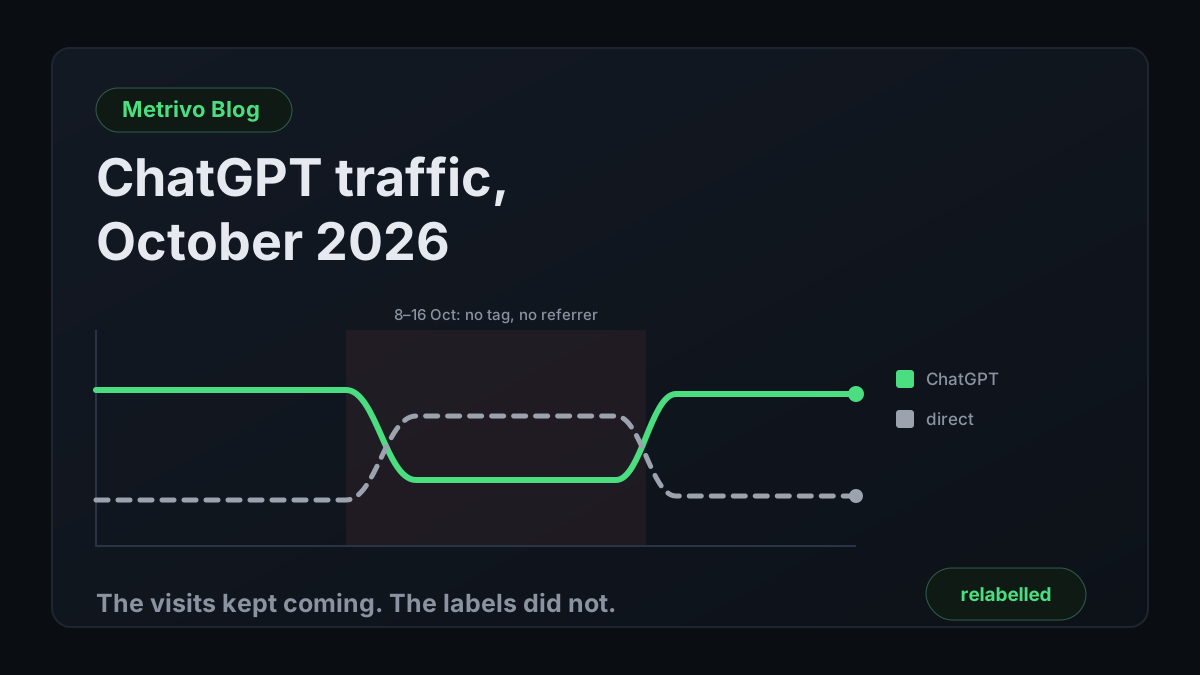
What happened, in order
Concise answer
For about a week in October 2026, most links in ChatGPT answers carried neither a tracking tag nor a referrer. Visits still happened, but many analytics tools could no longer tell they came from ChatGPT.
The first public signal was a sharp fall in ChatGPT referrals in analytics dashboards from 8 and 9 October. Within days, several independent sources had connected it to the same cause: links in ChatGPT answers no longer carried the utm_source=chatgpt.com parameter that ChatGPT had been adding to many cited links, and they did not send a referrer either. With neither signal present, a visit from ChatGPT looks exactly like someone typing your address, and most analytics tools file it under direct.
The timeline below is assembled from the sources listed at the end of this article. Times are as each source reported them, and the sources do not agree on the exact start, which is normal for an issue that rolled out unevenly across users and answer formats.
| When | What was reported | Reported by |
|---|---|---|
| 8 Oct, about 18:30 UTC | Share of answers with tagged cited links starts falling, concentrated in the newer Intelligent UI answer format | Profound, from its own monitoring of ChatGPT answers |
| 8 Oct, about 2pm Pacific | Tag stops being added; attributable ChatGPT visits fall to about a third of normal within hours | Cedric Huesler (Adobe), via Relevant Audience |
| 9 to 11 Oct | Daily ChatGPT sessions in GA4 down about 46 percent across monitored sites; total traffic down about 2 percent | LLM Pulse |
| 9 to 13 Oct | On about 500 pages, ChatGPT visits down about 31,000 a day, direct visits up about 26,000 a day | Cedric Huesler (Adobe), via Evertune |
| 14 Oct | Search Engine Roundtable reports that ChatGPT appears to have removed UTM parameters from its links | Search Engine Roundtable |
| 14 Oct | OpenAI tells Huesler privately that it is a bug; no public statement | Search Engine Journal, Relevant Audience |
| 14 Oct, about 19:00 UTC | Share of answers with tagged cited links falls sharply, to about 10 percent | Profound |
| 15 Oct, from about 2am Pacific | Fix begins rolling out; by 9am Pacific tagged clicks back near the level of a week earlier | Cedric Huesler, via Relevant Audience |
| 16 Oct, about 06:30 UTC | About 99 percent of answers with cited links tagged again; about 96 percent within Intelligent UI | Profound |
| As of 20 Oct | Referrer still missing on most ChatGPT clicks; no OpenAI statement or release-note entry found | Relevant Audience, Search Engine Journal, our own search |
What we know about the cause, and what we do not
Profound's analysis is that the newer Intelligent UI answer format, which shows links directly inside answers, lost the tag, while some links opened from product or information panels kept it. That is Profound's assessment from its own data, not an OpenAI explanation.
The only account of OpenAI's view comes from Cedric Huesler of Adobe, who wrote that OpenAI confirmed to him on 14 October that it was a bug and that a fix was coming. Search Engine Journal and Relevant Audience both reported this, and both noted that the confirmation is secondhand and that OpenAI had not mentioned the issue in its release notes. Until OpenAI says otherwise, treat the bug explanation as probable rather than confirmed.
Lost visits or lost labels?
Concise answer
The strongest evidence says most of the drop was relabelling: the visits still arrived, but as direct. The evidence is not strong enough to say that no visits were lost.
The question matters because the two readings lead to opposite decisions. If ChatGPT really sent half as many visitors, your visibility in ChatGPT answers fell and you might respond with content work. If ChatGPT sent the same visitors under a different label, nothing about your visibility changed and the right response is to fix the report.
Huesler's page-level comparison is the clearest evidence. On roughly 500 pages where ChatGPT had driven at least 5 percent of visits, ChatGPT-attributed visits fell by about 31,000 a day week over week, while direct visits on the same pages rose by about 26,000 a day. If ChatGPT had simply sent fewer people, direct traffic on those specific pages would have had no reason to rise.
LLM Pulse reported a roughly 46 percent fall in ChatGPT sessions across the sites it monitors while total traffic moved by only about 2 percent, which is consistent with relabelling. Its authors were careful to say that at site level the rise in direct was hard to see and that aggregate analytics cannot fully separate the two explanations. Graphite's CEO estimated the fall in GA4 ChatGPT sessions at 22 to 57 percent depending on the site, an approximate 45 percent fall overall.
Why page-level beats site-level for this question
Direct traffic is large and noisy on most sites. A few thousand relabelled visits disappear into it at site level, which is why some analysts could not see the rise. At page level the signal is much cleaner: on a deep article or comparison page that rarely gets typed-in visits, a sudden rise in direct entrances in the same days that ChatGPT entrances fell is hard to explain any other way.
The pages to examine are the ones where ChatGPT already accounted for a meaningful share of entrances before 8 October. Pages with little ChatGPT traffic will not show a readable pattern either way.
What is still broken after the fix
Concise answer
The tag came back; the referrer mostly did not. Any tool that identifies ChatGPT only from the referrer will keep filing most ChatGPT visits as direct.
Huesler's update on 15 October noted that the referrer is still missing on most ChatGPT clicks, which leaves the tag as the main signal. That changes how fragile your ChatGPT reporting is. Before October, a visit often had two independent pieces of evidence, the referrer and the tag. Now it often has only one, and it is the less reliable of the two, because the tag is added by ChatGPT at its discretion and was never present on every link.
Seer Interactive's long-running testing found that ChatGPT tended to tag links used as cited sources but not plain search results, that even cited links were not guaranteed to carry the tag, and that the behaviour has changed across models and releases. October was not the first change to ChatGPT's linking behaviour and is unlikely to be the last.
Test whether your tools recognize the tag on its own
Some analytics tools only recognize ChatGPT from the referrer and treat utm_source=chatgpt.com as an ordinary, unknown campaign source. With the referrer gone, those tools would show ChatGPT traffic as a referral or campaign named chatgpt.com, or as direct, rather than as an AI source.
You can test this in two minutes. Open a private browser window, paste your own landing page address with ?utm_source=chatgpt.com appended so that no referrer is sent, browse a page or two, and then look at how the session is classified in each tool you use. Repeat with a URL that has no tag at all to confirm the baseline. If the tagged visit is not classified as ChatGPT or AI, your ChatGPT numbers are understated whenever the referrer is missing, which is now most of the time.
How to correct your reports for 8 to 16 October
Concise answer
Annotate the window, estimate relabelled visits page by page, and keep the estimate separate from confirmed data. Do not apply a single multiplier to scale the missing week back up.
The temptation is to take a published drop percentage and divide your October numbers by it. Profound, whose monitoring produced some of the clearest data on this incident, warns explicitly against using its figures as a multiplier to correct traffic or revenue reports. The effect varied by answer format, by site, and by day, so a single factor would replace one wrong number with another.
A more defensible approach treats the correction as an estimate with a visible label. It will never be exact, because the visits that lost their label are indistinguishable from real direct visits one by one. What you can do is bound the effect and report it honestly.
A page-level estimate you can defend
Choose the pages where ChatGPT accounted for a meaningful share of entrances in the two weeks before 8 October. For each page, compare daily ChatGPT entrances and daily direct entrances for 8 to 16 October with the same weekdays in the week before. On each page, the estimated relabelled visits are the smaller of two numbers: the fall in ChatGPT entrances and the rise in direct entrances. Taking the smaller number avoids crediting ChatGPT with a direct rise that exceeds what ChatGPT lost, or with a ChatGPT fall that direct never absorbed.
To illustrate with hypothetical numbers: a comparison page averaged 120 ChatGPT entrances and 30 direct entrances a day the week before, and 55 ChatGPT and 85 direct during the affected week. ChatGPT fell by 65 and direct rose by 55, so the estimate is 55 relabelled visits a day for that page, and the remaining 10 stay unexplained. Sum the estimates across pages and report them as estimated ChatGPT visits, alongside, not inside, confirmed ChatGPT visits.
In GA4, an exploration with landing page and session source or medium as dimensions, sessions as the metric, and a date comparison against the previous period gives you the inputs. Any analytics tool that can break entrances down by landing page, source, and day can do the same.
Revenue from the affected week
Signups and payments from relabelled visits will be attributed to direct, or left unattributed, for the rest of their life in your reporting. If you judge ChatGPT as a channel on revenue, and you should, either exclude 8 to 16 October from the comparison window or extend the window long enough that one week cannot dominate the result. Do not move individual payments from direct to ChatGPT on the strength of a page-level estimate; the estimate is about volumes, not about which specific visitor came from where.
Make your attribution survive the next change
Concise answer
Use several independent signals, keep a confidence label on every match, watch the tagged share daily, and keep unknown traffic visible instead of folding it into a channel.
The October incident is a clean demonstration of a general risk: AI assistants control how their links are formed, and they can change that behaviour in a release without notice. Reporting that depends on a single field from a single platform will break whenever that field changes. The practices below do not prevent the next change, but they make it visible within a day and stop it from silently rewriting your channel history.
- Capture the full landing URL, including the query string, at first touch and keep it on the session, so a tag that arrives on the first page view survives later redirects and navigation.
- Treat referrer, campaign tag, and landing-page evidence as separate signals, and record which ones each attributed visit actually had.
- Label confidence. A visit identified by a verified referrer is stronger evidence than one identified by a tag alone, and both are stronger than an inference from page patterns.
- Watch the daily share of entrances on your top AI-cited pages that carry an AI signal. A sudden fall paired with a direct rise on the same pages is a tracking change, not a demand change.
- Keep unknown and direct traffic visible as their own buckets. Folding unknown visits into a channel makes the next incident impossible to see.
- Judge channels on payments over a long enough window that one bad week of labels cannot move the conclusion.
How Metrivo treats ChatGPT visits now
Concise answer
Metrivo identifies ChatGPT from a chatgpt.com referrer at high confidence and from the utm_source=chatgpt.com tag alone at low confidence, and it leaves visits with neither signal as direct or unknown.
Metrivo is built for SaaS founders who are their own growth team, so it focuses on whether a channel produced paying customers rather than on session counts alone. For ChatGPT specifically, the current behaviour is as follows.
A visit whose referrer host is chatgpt.com or chat.openai.com is classified as ChatGPT with high confidence, because the browser reported it. A visit with no referrer but with utm_source=chatgpt.com is classified as ChatGPT with low confidence, because the tag is declared by the link rather than verified by the browser. Host-style tags are matched strictly, so a lookalike such as notchatgpt.com is not treated as ChatGPT. A visit with neither signal stays direct or unknown, and Metrivo does not relabel it as AI traffic based on patterns.
Payments are matched to these sessions through verified provider webhooks or the Manual Payment API, each with its own attribution confidence label, and unattributed revenue stays visible. The definitions are in the attribution confidence docs, and the broader method for hidden AI traffic is covered in why ChatGPT traffic shows as direct.
What Metrivo cannot do is recover the label on a visit that arrived with no evidence at all. Visits from 8 to 16 October that carried neither a tag nor a referrer are direct in Metrivo just as they are everywhere else, and any page-level estimate of them should be reported as an estimate.
A short checklist for this week
Concise answer
Five checks, most of which take minutes, close out the October incident and leave you better prepared for the next one.
Work through these in order. The first two protect every report you will produce about October; the rest reduce the damage from the next change.
- Add an annotation for 8 to 16 October 2026 to every dashboard that shows ChatGPT, AI, or direct traffic.
- Run the private-window test with ?utm_source=chatgpt.com in each analytics tool you rely on, and note which ones classify it as ChatGPT.
- Produce a page-level estimate of relabelled visits for your top ChatGPT pages, labelled as an estimate.
- Exclude the affected week, or use a longer window, when comparing ChatGPT revenue against other channels.
- Set up a daily check on the AI-signal share of entrances to your top AI-cited pages, so the next change shows up in a day rather than a week.
Frequently asked questions
Why did my ChatGPT traffic drop in October 2026?
From around 8 October 2026, links in ChatGPT answers arrived without the utm_source=chatgpt.com tag and without a referrer, so many analytics tools recorded those visits as direct. Page-level comparisons showed direct traffic rising as ChatGPT traffic fell, which indicates the visits were mostly relabelled rather than lost.
Is the ChatGPT UTM problem fixed?
Largely, for the tag. Independent monitoring showed about 99 percent of answers with cited links tagged again by 16 October 2026. The referrer is still missing on most ChatGPT clicks, so tools that rely only on the referrer will continue to undercount ChatGPT.
Did OpenAI confirm the bug?
Not publicly. The only account is from Adobe's Cedric Huesler, who reported that OpenAI told him privately on 14 October 2026 that it was a bug. OpenAI's release notes did not mention the issue or the fix as of 20 October 2026.
Should I adjust my October numbers with a multiplier?
No. The effect varied by answer format, site, and day, and Profound, whose data documented the incident, warns against using its figures as a correction multiplier. Estimate relabelled visits page by page by comparing ChatGPT and direct entrances on the same pages, and report the result as an estimate.
Will ChatGPT traffic show as direct again in the future?
It already does whenever a link lacks both the tag and the referrer, which happens for some links even now. Assistants control how their links are formed and can change that behaviour in any release, so assume it can happen again and monitor the share of AI-signalled entrances on your top pages daily.
How do I check if my analytics tool recognizes utm_source=chatgpt.com?
Open a private browser window, visit one of your pages with ?utm_source=chatgpt.com added to the address so no referrer is sent, and check how the session is classified. If it is not labelled as ChatGPT or AI traffic, your tool undercounts ChatGPT whenever the referrer is missing.